

PCOS vs PMOS: Name Change & New Diet Plan for Women
Key Takeaways
- In May 2026, a global coalition of medical societies formally retired the name Polycystic Ovary Syndrome (PCOS) in favor of Polyendocrine Metabolic Ovarian Syndrome (PMOS) — the same condition, a more accurate name.
- The change followed more than a decade of research and a survey of over 22,000 patients, led by Monash University alongside the Endocrine Society, ASRM, and the AE-PCOS Society.
- Studies behind the renaming found no increase in true abnormal ovarian cysts among women with the condition — the old name was misleading from the start.
- Your diagnosis code, lab work, and treatment plan are not changing overnight. Florida clinics will phase in the new terminology over the next few years, with full adoption expected by 2028.
- The nutrition approach that helps PCOS also helps PMOS: a protein-and-fiber-forward, anti-inflammatory eating pattern that supports insulin sensitivity — not a brand-new diet, but a more informed one.
If you’re new to this condition, our 7-Day PCOS Meal Plan for Beginners and PCOS Grocery List are good starting points alongside this guide.
Introduction
If you were diagnosed with Polycystic Ovary Syndrome years ago, you may have recently seen an unfamiliar acronym circulating in health forums, patient groups, and even your doctor’s office: PMOS. You haven’t developed a new condition. What happened is that the condition you already manage every day has been given a name that finally matches the science.
For women across Florida — a state with one of the largest populations of reproductive-age women living with this diagnosis — this shift (PCOS vs PMOS) raises real, practical questions. Will insurance still recognize the old diagnosis code? Does your treatment plan change? And most importantly for day-to-day life: does anything about the diet plan you’ve been following need to change?
This guide walks through exactly what happened, why it happened, what it means for women being diagnosed or managed in Florida, and how the nutrition strategy for this condition has evolved alongside the name. The new PMOS diet plan includes these 25 PCOS snacks for better blood sugar control.
What Was PCOS, Exactly?
Polycystic Ovary Syndrome has been the working name since the 1930s for a hormonal condition affecting roughly one in eight women of reproductive age worldwide. It typically involves some combination of:
- Irregular or absent ovulation and menstrual cycles
- Elevated androgen levels (acne, excess facial or body hair, scalp thinning)
- Insulin resistance and related metabolic changes
- Small follicles on the ovaries, historically mislabeled as “cysts”
The trouble is baked into the old name itself. “Polycystic” told women and even many clinicians that this was fundamentally an ovarian problem involving actual cysts. In reality, the follicles seen on ultrasound are immature egg sacs, not the fluid-filled cysts most people picture, and a large share of women with the condition never show this feature on imaging at all. Meanwhile, the more consequential parts of the condition — insulin resistance, cardiometabolic risk, and endocrine disruption throughout the body — were left out of the name entirely.
If you’re making diet changes, first make sure you’re dealing with PCOS. See our complete PCOS Symptoms Guide: 20 Signs, Causes and When to See a Doctor (2026)
The Name Change: How PCOS Became PMOS
On May 12, 2026, a paper published in The Lancet announced the outcome of a global, multistep consensus process: Polycystic Ovary Syndrome would officially be renamed Polyendocrine Metabolic Ovarian Syndrome, or PMOS.
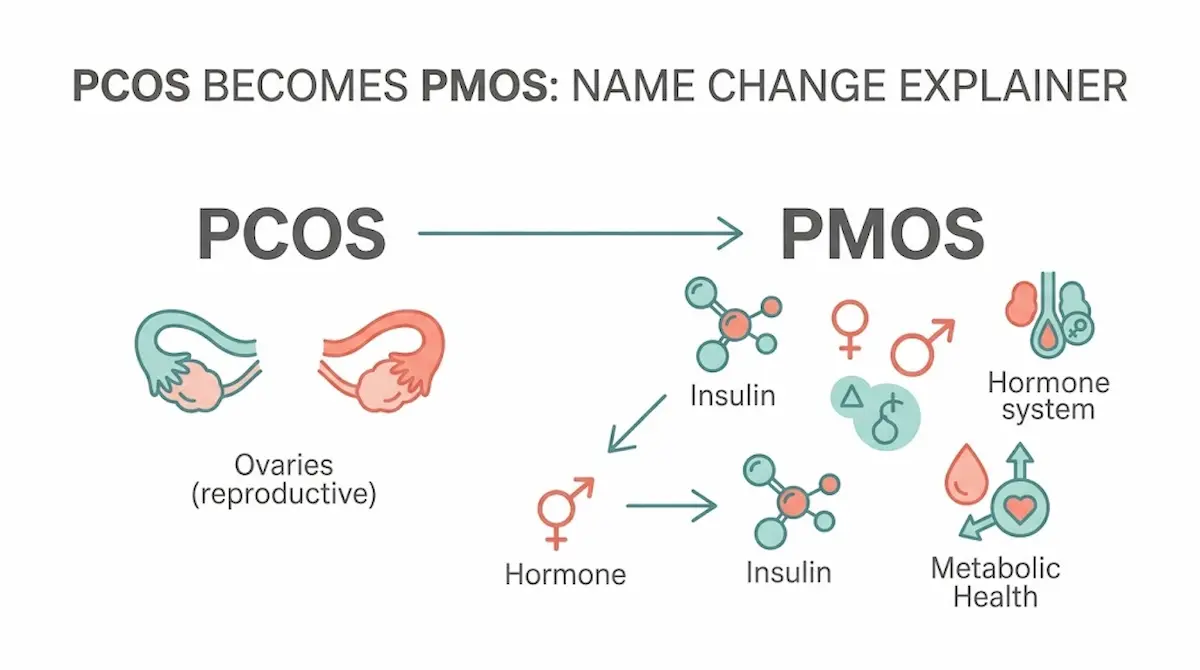
This wasn’t a marketing decision made by a single organization. It was the product of:
- Over 22,000 survey responses from patients and clinicians gathered over more than a decade
- 56 patient and professional organizations participating in the consensus process, including the Endocrine Society, the American Society for Reproductive Medicine (ASRM), the International Androgen Excess and PCOS Society (AE-PCOS Society), and the UK charity Verity
- Delphi surveys, nominal group workshops, and formal naming-science assessments to land on a term that was both accurate and usable in clinics worldwide
- A companion research paper showing no increase in abnormal ovarian cysts among women with the condition — direct evidence that “polycystic” was scientifically misleading
The process was led by Professor Helena Teede of Monash University, working alongside AE-PCOS Society leadership and patient advocates. According to reporting on the announcement, roughly 86% of surveyed patients and 71% of surveyed healthcare professionals supported moving to a name that was symptom-based and biologically accurate rather than keeping the PCOS acronym for the sake of familiarity.
What Does “Polyendocrine Metabolic Ovarian Syndrome” Actually Describe?
Each part of the new name reflects a piece of the condition that “polycystic” left out:
| Term Component | What It Reflects |
|---|---|
| Polyendocrine | Multiple hormone systems are involved — not just reproductive hormones, but insulin, cortisol, and thyroid interactions too. |
| Metabolic | Insulin resistance, weight regulation, and long-term cardiometabolic risk are core features, not side notes. |
| Ovarian | The reproductive and ovulatory features remain part of the picture, without implying disease-causing cysts. |
The Rollout Timeline of PCOS vs PMOS
Medical and scientific organizations expect the transition to unfold gradually rather than overnight:
- 2026: Major societies (Endocrine Society, ASRM, AE-PCOS Society) formally endorse and begin using PMOS in new guidelines and communications.
- 2026–2028: Clinics, journals, and patient materials gradually phase in the new terminology.
- 2028 (projected): PMOS is expected to formally replace PCOS in the International Classification of Diseases (ICD), the coding system used globally, including by U.S. insurers.
In practical terms, this means diagnostic and billing codes tied to “PCOS” will remain valid for the next several years. No woman needs to worry about her existing diagnosis, prescriptions, or insurance coverage lapsing because of a terminology update.
Why the Change Matters (Beyond Semantics) PCOS vs PMOS
It’s fair to ask whether a name change really changes anything for the woman living with the condition day to day. Advocates involved in the process argue it does, for a few concrete reasons:
- Fewer missed and delayed diagnoses. When the name centers on “cysts,” both patients and clinicians can under-recognize the condition in women who don’t show that ultrasound feature, delaying care.
- Better-targeted treatment. A name that acknowledges the metabolic and endocrine scope of the condition supports care plans that address insulin resistance and cardiometabolic risk — not just menstrual irregularity.
- Reduced stigma. Rachel Morman, chair of the UK charity Verity and a patient herself, has pointed out that large numbers of both patients and professionals still mistakenly believe the condition centers on dangerous ovarian cysts — a misunderstanding that has caused unnecessary anxiety for decades.
- More research funding. A name that accurately reflects the metabolic and cardiovascular burden of the condition may open doors to research funding streams that a narrowly “reproductive” label historically did not.
What This Means for Women in Florida
HavenHer.org is based in St. Petersburg, Florida, and much of our reader base is managing this condition in the Florida healthcare system specifically — so here’s what to actually expect locally over the next few years.
- Your diagnosis code won’t disappear overnight. Florida OB-GYNs, endocrinologists, and primary care providers will continue to use existing PCOS-linked billing and diagnostic codes until the ICD update takes effect. Insurance coverage for labs, ultrasounds, and medications tied to your diagnosis is not affected by the name change itself. So PCOS vs PMOS is not to worry about.
- Ask your provider which term they’re using. Some Florida practices, especially those affiliated with academic centers, may already be transitioning to PMOS in their charting and patient materials. Others will lag behind. Either term currently refers to the same clinical entity.
- Telehealth and specialist access. Florida’s rural and semi-rural counties often have long waits for reproductive endocrinologists. Telehealth visits remain a practical bridge for women seeking guidance on either PCOS or PMOS management while local terminology catches up.
- Local diet resources work in your favor. Florida’s year-round access to fresh Gulf seafood, citrus, leafy greens, and low-cost produce (particularly through farmers markets in Tampa Bay, Orlando, and South Florida) makes the metabolic-focused eating pattern below easier to build than in many other states.
The New Diet Plan: What Changes and What Doesn’t
Here’s the most important reassurance in this entire guide: the underlying nutrition science has not changed. What has changed is that the new name puts the metabolic piece of the condition front and center, which is a useful reminder to revisit why diet matters so much in managing it, PCOS vs PMOS.
The eating pattern that supported PCOS management is the same one that supports PMOS management, because it targets the same underlying driver: insulin resistance, which affects an estimated 70–80% of women with this condition and directly influences androgen production, cycle regularity, and metabolic risk.
Core Principles of the PMOS Diet Plan

- Protein at every meal. Aim for 20–30g of protein at breakfast, lunch, and dinner. Protein slows gastric emptying and blunts post-meal blood sugar spikes.
- Fiber crowding. Add chia seeds, flaxseeds, lentils, berries, or leafy greens to at least two meals a day. Fiber slows glucose absorption and supports a healthier gut microbiome.
- Smart carbohydrate pairing. Never eat carbohydrates alone. Pair fruit with yogurt, toast with eggs, or rice with beans to reduce the insulin demand of any single meal.
- Anti-inflammatory fats. Olive oil, avocado, fatty fish, and nuts support hormone regulation and help offset the low-grade inflammation associated with the metabolic features now explicitly named in PMOS.
- Consistent meal timing. Irregular eating patterns can worsen insulin resistance. Aim for meals spaced 4–5 hours apart to keep blood sugar steadier throughout the day.
Building a Blood-Sugar-Balancing Plate
| Portion | What Goes There |
|---|---|
| Half the plate | Non-starchy vegetables (spinach, peppers, cauliflower, zucchini) |
| One quarter | Lean protein (Gulf shrimp, salmon, chicken, tofu, eggs) |
| One quarter | Slow-digesting carbohydrates (quinoa, sweet potato, brown rice, black beans) |
| A drizzle | Healthy fat (olive oil, avocado) |
A Florida-Friendly Sample Day
Breakfast: Greek yogurt with chia seeds and fresh Florida strawberries Lunch: Blackened Gulf shrimp bowl with quinoa, black beans, avocado, and citrus dressing Dinner: Baked salmon with roasted broccoli and a small portion of brown rice Snack: A handful of almonds with an orange
This mirrors the same protein-fiber-smart-carb framework covered in our PCOS Insulin Resistance Diet Guide and 20 PCOS Dinner Ideas — because, again, the metabolic target hasn’t moved, only the name has.
Lifestyle Factors That Support the Diet Plan
- Move after meals. A 10–15 minute walk after eating helps muscles absorb glucose without relying solely on insulin.
- Protect your sleep. Even one night of poor sleep can temporarily worsen insulin resistance. Aim for 7–9 hours.
- Manage stress deliberately. Elevated cortisol raises baseline blood sugar. Brief breathwork, journaling, or a short walk outdoors can help, especially useful in Florida’s outdoor-friendly climate for much of the year.
Talking to Your Florida Provider About the Name Change
If you want to bring this up at your next appointment, consider asking:
- “Are you currently using PCOS or PMOS in my chart, and does that affect anything about my care plan?”
- “Will my current diagnosis code and prescriptions carry over once PMOS is formally adopted?”
- “Given the metabolic emphasis in the new name, should we revisit my insulin resistance screening or cardiometabolic risk labs?”
These are reasonable, informed questions, and a provider familiar with current guidelines should be able to answer all three without difficulty. Whether you call it PCOS or PMOS, stress plays a huge role in symptoms.
High cortisol impacts both. Here’s how to manage stress for better hormone health: PCOS and Stress: The Cortisol Connection.
Frequently Asked Questions
Is PMOS a different condition from PCOS?
No. PMOS (Polyendocrine Metabolic Ovarian Syndrome) is simply the new, more accurate name for the exact same condition previously called PCOS (Polycystic Ovary Syndrome). If you were diagnosed with PCOS, you have PMOS under the updated terminology — nothing about your physiology has changed.
Will my insurance still cover treatment if the name changed?
Yes. Existing PCOS-linked diagnostic and billing codes remain valid, and the formal transition to PMOS coding in the International Classification of Diseases isn’t expected until around 2028. Your current coverage, prescriptions, and lab orders are not affected by the terminology (PCOS vs PMOS) update.
Do I need to start a completely new diet because of PMOS?
No. The nutrition strategy that supports insulin sensitivity and hormone balance for PCOS is the same strategy that supports PMOS, because both names describe the identical underlying metabolic and endocrine physiology. The name change is a reason to revisit the importance of a protein-and-fiber-forward diet, not to abandon what’s already working for you.
Why did it take so long to change the name?
The process involved more than a decade of research, over 22,000 patient and clinician survey responses, and coordination across 56 international patient and professional organizations. Renaming a globally recognized medical condition requires this level of consensus to avoid confusion in research, billing, and patient care.
Where can I learn more about managing this condition day to day?
Explore our related guides on the PCOS Grocery List, 7 Easy PCOS Breakfast Ideas, and PCOS Hair Loss & Acne Treatment for practical, evidence-based support.
References & Scientific Guidelines
- The Lancet (May 2026): Multistep global consensus paper announcing the renaming of PCOS to Polyendocrine Metabolic Ovarian Syndrome (PMOS).
- Endocrine Society Newsroom (May 2026): Official statement endorsing PMOS as the new name, developed with more than 50 patient and professional organizations.
- American Society for Reproductive Medicine (ASRM): Endorsement statement on the PCOS-to-PMOS transition and its implications for fertility care.
- International Evidence-Based PCOS Guideline (2023): Continues to inform individualized nutritional planning under the updated terminology.
- NCBI/PMC research on insulin resistance prevalence in women with this condition, cited in our related PCOS Insulin Resistance Diet Guide.
Medically reviewed by Consultant Dr. Mehwish Saif, MBBS, FCPS Obstetrics & Gynaecology.
Medical Disclaimer: This information is for educational purposes only. It is not a substitute for professional medical advice, diagnosis, or treatment. Always consult your healthcare provider before making changes to your diagnosis understanding, medication, or diet.
HavenHer.org 📍 7901 4th St N STE 17639, ST PETERSBURG, FL USA 33702 📞 0017162951575 💬 WhatsApp Chat
Tags: #PMOS #PCOS #Name Change #PCO Guide 2026 #Insulin Resistance