

Ever felt like your PMS is just… too much? Like it is not just the usual mood swings or a bit of bloating, but something that genuinely derails your entire week?
You are not imagining it. And you are absolutely not being dramatic.
There is a real, clinically recognized difference between PMS and PMDD — premenstrual dysphoric disorder — and millions of women are living with the more severe version without ever being told there is a name for what they experience, let alone a treatment.
This guide breaks down the difference between PMS and PMDD in plain language, gives you the full symptom checklist, and walks you through what to do next. PMS vs PMDD is one of the most searched women’s health questions online, and yet most women still leave their doctor’s office without a clear answer.
Let’s change that.
What Is PMS?
PMS stands for premenstrual syndrome. It is the group of physical and emotional symptoms that appear in the days before your period and disappear once your period starts or shortly after.
Most women with PMS experience some combination of:
- Mild to moderate mood changes — feeling irritable, tearful, or anxious
- Bloating and water retention
- Breast tenderness
- Headaches
- Food cravings, especially for sugar or salt
- Fatigue and disrupted sleep
- Mild difficulty concentrating
PMS is very common. Research suggests around 75% of menstruating women experience some form of premenstrual symptoms at some point in their lives. For most women, PMS is manageable. It is uncomfortable and sometimes frustrating, but it does not stop you from going to work, seeing friends, or getting through your day.
That is the key distinction. PMS is annoying. PMDD is disabling.
If your periods are also irregular, read our guide on irregular periods and what causes them.
What Is PMDD? Premenstrual Dysphoric Disorder Explained
PMDD is not just severe PMS. This is the most important thing to understand before reading anything else on this page.
Premenstrual dysphoric disorder is a distinct clinical diagnosis listed in the DSM-5, the Diagnostic and Statistical Manual of Mental Disorders, Fifth Edition — the same reference guide that clinicians use to diagnose depression and anxiety disorders. It is also recognized by the WHO under ICD-11. PMDD was officially recognized as its own separate disorder in 2013.
The difference is not just about how bad the symptoms feel. It is about their nature, their intensity, and the way they interfere with your life.
With PMDD, the PMDD symptoms are primarily mood-based and neurological. You may feel severe depression, rage that feels out of proportion, crushing anxiety, or a deep sense that life feels unbearable — and then your period starts, and within a few days, those feelings lift completely. That cyclical pattern, tied specifically to the luteal phase, is the clinical fingerprint of PMDD.
Research confirms that PMDD has a neurobiological basis: women with PMDD have an altered sensitivity to normal hormonal fluctuations — specifically to progesterone and its metabolite allopregnanolone — which affects GABA and serotonin systems in the brain. This is not a personality trait. This is brain chemistry responding abnormally to normal hormonal changes.
PMDD affects an estimated 3 to 8% of menstruating women in the United States, according to DSM-5 prevalence data.
💡 From Dr. Mehwish Saif
“PMDD is one of the most underdiagnosed conditions I encounter at my St. Pete practice. Women come in having been told for years that they are ‘just emotional’ or ‘need to manage their stress better.’ When we do a proper symptom timeline and it lines up perfectly with their luteal phase, the relief on their faces is profound. There is a real diagnosis. There is real treatment. You do not have to keep pushing through this.”
PMS vs PMDD: The 7 Key Differences
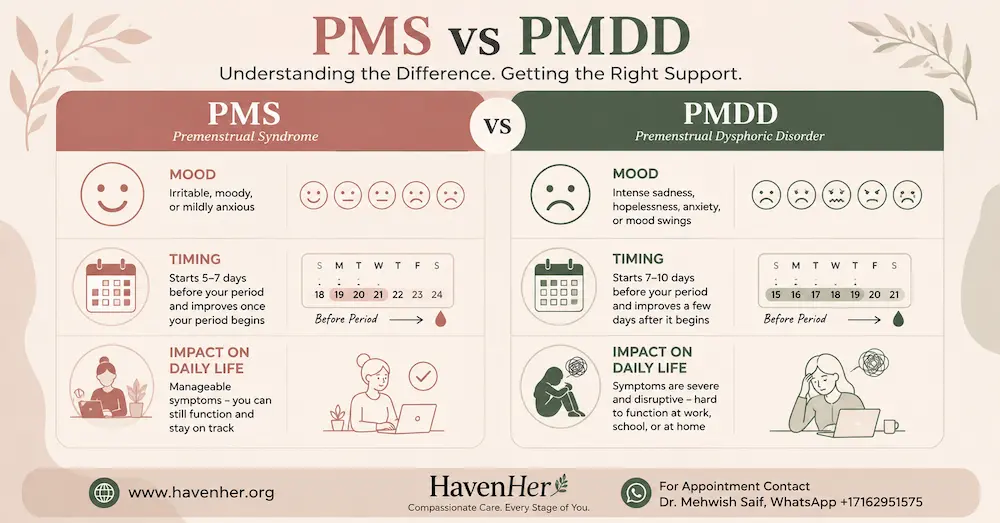
This is the comparison most women are searching for. Here is an honest, clinical side-by-side.
| Feature | PMS | PMDD |
|---|---|---|
| Cause | Normal hormonal fluctuations in the luteal phase triggering mild physical and mood changes | Abnormal neurobiological sensitivity to normal hormonal fluctuations, affecting serotonin and GABA systems |
| Mood Symptoms | Mild irritability, moodiness, tearfulness, and minor anxiety | Severe depression, rage, emotional overwhelm, feelings of hopelessness, suicidal thoughts in some cases |
| Physical Symptoms | Bloating, breast tenderness, headaches, fatigue, food cravings | Same physical symptoms, but they coexist with severe psychiatric symptoms that dominate the experience |
| Severity | Uncomfortable but manageable. Most women can continue daily activities. | Disabling. Many women with PMDD miss work, cancel plans, and experience relationship breakdown during episodes. |
| Timing and Duration | Begins in the second half of the cycle, resolves within a few days of period starting | Begins in the luteal phase (1-2 weeks before period), resolves within days of menstruation onset. Must occur in most cycles over the past year. |
| Impact on Daily Life | Minor disruption to mood and comfort | Significant impairment in work, relationships, social functioning, and mental health |
| Treatment | Lifestyle adjustments, dietary changes, OTC pain relief, stress management | Requires clinical management: SSRIs (FDA-approved), hormonal therapies, CBT, and structured lifestyle support |
🔍 My Answer for: What Is the Difference Between PMS and PMDD?
PMS (premenstrual syndrome) causes mild to moderate physical and emotional symptoms before a period that do not significantly interfere with daily life. PMDD (premenstrual dysphoric disorder) is a clinically diagnosed condition involving severe mood symptoms — including depression, rage, and anxiety — that are disabling and tied specifically to the luteal phase of the menstrual cycle. PMDD requires at least 5 of 11 DSM-5 symptoms present in most cycles over the past year.
PMDD Symptoms Checklist: The 11 DSM-5 Criteria
To be diagnosed with PMDD, you must have at least 5 of these 11 symptoms, including at least one mood symptom, in most cycles over the past year:
- ★ Marked affective lability — sudden mood swings, feeling suddenly sad or tearful or increased sensitivity to rejection
- ★ Marked irritability or anger — persistent irritability or anger that affects other people
- ★ Marked depressed mood — feelings of hopelessness or self-deprecating thoughts
- ★ Marked anxiety or tension — feeling on edge, keyed up, or unusually anxious
- Decreased interest in usual activities — things you normally enjoy feel flat or pointless
- Difficulty concentrating — brain fog, trouble focusing, feeling scattered
- Fatigue or low energy — exhaustion disproportionate to activity level
- Significant change in appetite — overeating, food cravings, or loss of appetite
- Changes in sleep — insomnia, or sleeping too much and still feeling unrefreshed
- Feeling overwhelmed or out of control — a sense that you cannot cope
- Physical symptoms — breast tenderness, bloating, joint or muscle pain, weight gain sensation
The symptoms must:
- Be present in the luteal phase (the week or two before your period)
- Resolve within a few days of your period starting
- Be absent the week after your period
- Occur in most cycles over the past year
- Be severe enough to meaningfully interfere with your work, relationships, or daily functioning
The clinical gold standard for diagnosis is prospective symptom tracking — recording your symptoms daily for at least two menstrual cycles using a validated tool like the Daily Record of Severity of Problems (DRSP).
Is It PMS or PMDD? Ask Yourself This:
When your period arrives, do your emotional symptoms lift within one to two days? If yes — and if those symptoms were severe enough to affect your work, relationships, or ability to function — that cyclical pattern is a hallmark of PMDD. If your symptoms continue throughout your period and between cycles, another diagnosis may be more appropriate. A symptom diary over two cycles, shared with your doctor, gives the clearest picture.
Why PMDD Happens: Is It Hormones or Brain Chemistry?
Both. And understanding this changes how you see yourself.
Women with PMDD do not have abnormal hormone levels. Their oestrogen and progesterone are in the normal range. What is different is how their brain responds to those normal hormonal changes.
During the luteal phase, progesterone metabolises into a compound called allopregnanolone, which normally has a calming effect on the brain through GABA receptors. In women with PMDD, research shows their GABA-A receptors respond abnormally to allopregnanolone — meaning the usual calming effect does not work, or even triggers the opposite response.
Serotonin sensitivity is also disrupted. This is why SSRIs — medications that work on the serotonin system — are effective for PMDD. Uniquely, women with PMDD often respond to SSRIs within days, not the weeks it typically takes for depression, which reflects how fundamentally different the mechanism is.
This also means: PMDD mood swings are not a character flaw. They are not weakness. They are a neurobiological event tied to a predictable hormonal pattern.
Researchers have also noted that women with a personal or family history of depression, anxiety, trauma, or PTSD appear to have a higher risk of PMDD. If stress and cortisol are making your symptoms worse, read our guide on PCOS and stress hormones to understand the connection.

When to See a Doctor: Red Flags You Should Not Ignore
Please do not wait until things get unbearable. You deserve a diagnosis and a management plan now.
Book an appointment if:
- Your premenstrual symptoms are regularly severe enough to affect your work, relationships, or daily life
- You are experiencing deep depression, hopelessness, or rage that feels out of proportion
- You have thoughts of harming yourself during the premenstrual window
- Your symptoms have been going on for several cycles and are not improving
- You have tried lifestyle changes and they are not enough
- Your partner, family, or colleagues have noticed a significant change in you premenstrually
Seek immediate care if you are experiencing suicidal thoughts, even if they feel cyclical or tied to your period. Call or text the 988 Suicide and Crisis Lifeline (call or text 988 in the US). You are not alone and help is available right now.
In the Tampa Bay area, Dr. Mehwish Saif at our St. Pete practice on N 79th Avenue provides comprehensive hormonal evaluations for women experiencing severe premenstrual symptoms across Pinellas, Hillsborough, and Pasco counties. Call us at 001 716 295 1575 or email info@havenher.org.
Severe PMS Treatment and PMDD Treatment Options
Good news: PMDD responds well to treatment when it is identified correctly. Here is what the evidence supports.
1. Lifestyle and Diet Changes
These are not a cure for PMDD, but they genuinely reduce severity and are always worth starting.
- Regular aerobic exercise — three to five times per week. Exercise increases serotonin and reduces inflammation. A 2024 meta-analysis confirmed exercise as the most effective non-drug treatment for premenstrual symptoms.
- Reduce caffeine and alcohol — both disrupt sleep quality and amplify anxiety and mood instability in the luteal phase.
- Reduce refined sugar and ultra-processed food — blood sugar instability worsens mood swings. Stable blood sugar through regular, balanced meals with protein and fibre makes a measurable difference for many women.
- Consistent sleep schedule — sleep disruption worsens every PMDD symptom. Same bedtime and wake time, even through the hard days.
- Stress management — mindfulness-based cognitive therapy (MBCT) has evidence for PMDD. Even ten minutes of daily breathwork or guided meditation during the luteal phase supports the GABA system.
2. Supplements With Supporting Evidence
- Magnesium glycinate (300 to 400 mg daily) — supports GABA function, reduces anxiety and sleep disruption. Very well tolerated. Discuss dosing with your provider.
- Vitamin B6 (50 to 100 mg daily) — supports serotonin synthesis. Some evidence for mood improvement in PMS and PMDD.
- Calcium carbonate (1,200 mg daily) — multiple studies including a large RCT found calcium supplementation significantly reduced PMDD symptom scores.
- Omega-3 fatty acids (1 to 2 g EPA and DHA daily) — anti-inflammatory, supports mood regulation.
These are not substitutes for clinical treatment in moderate to severe PMDD, but they are safe additions to a broader management plan. For a full breakdown of which supplements have real evidence, read our PCOS Supplements Guide.
3. FDA-Approved Medications for PMDD
SSRIs (selective serotonin reuptake inhibitors) are the first-line, FDA-approved treatment for PMDD and the most robustly evidenced. A 2024 Cochrane review confirmed SSRIs are effective for PMDD.
FDA-approved SSRIs for PMDD include:
- Sertraline (Zoloft) — can be taken daily or only in the luteal phase
- Fluoxetine (Prozac/Sarafem) — daily or intermittent luteal-phase dosing
- Paroxetine CR (Paxil CR) — controlled release formulation
Other options your provider may discuss: hormonal suppression with drospirenone-containing birth control, GnRH analogues for treatment-resistant cases, and cognitive behavioral therapy (CBT) specifically adapted for PMDD.
Frequently Asked Questions: PMS vs PMDD
Can you have both PMS and PMDD?
Technically, PMDD replaces PMS as a diagnosis when the DSM-5 criteria are met. Women with PMDD often also experience the physical symptoms of PMS alongside the severe mood symptoms that define PMDD. A clinician can clarify through a proper evaluation and symptom diary review.
How long does PMDD last?
Each PMDD episode typically begins one to two weeks before a period (the luteal phase) and resolves within one to two days of menstruation starting. The acute episode lasts 7 to 14 days in most cycles. As a condition, PMDD is chronic and recurrent but responds well to treatment.
Is PMDD a mental illness?
PMDD is classified in the DSM-5 under depressive disorders and in the ICD-11 with a cross-listing under mood disorders. It has a measurable neurobiological mechanism — an abnormal brain response to normal hormonal fluctuations — and there are proven medical treatments. It is not a character weakness or something you can think your way out of. What the classification means is that you deserve access to evidence-based mental health treatments.
What helps PMDD immediately?
For same-day relief: magnesium glycinate in the evening, 20 to 30 minutes of aerobic movement, slow diaphragmatic breathing (4 counts in, 6 counts out), and reducing caffeine and sugar intake. If prescribed SSRIs at luteal-phase dosing, taking your dose as prescribed is the most effective immediate step. Seek medical care if symptoms are severe.
Conclusion
If you have been reading this article nodding along, thinking — yes, this is me, this is what happens every single month — then please hear this clearly: you are not too sensitive, too emotional, or too much.
You may have PMDD. And PMDD is real, diagnosable, and treatable.
The difference between PMS and PMDD is not just a matter of degree. It is a difference in mechanism, impact, and the type of support you deserve. Knowing the distinction means you can walk into a clinical appointment with the right language, the right tracking tools, and the confidence that you are not imagining your experience.
Start tracking your symptoms daily through your next two cycles. Use a simple app or a paper chart. Note the date, what you felt, and how severely it affected your day. Bring that record to your next appointment. It is the single most useful thing you can do right now.
Join the HavenHer newsletter for evidence-based women’s health content written in plain language, reviewed by Dr. Mehwish Saif, and designed for women who want real answers without the medical runaround.
📍 7901 4th St N, STE 17639, St. Petersburg, FL 33702
📞 001 716 295 1575
💬 WhatsApp: 001 716 295 1575
✉️ info@havenher.org
External Resources
- Office on Women’s Health — Premenstrual Dysphoric Disorder (PMDD)
- Cleveland Clinic — PMDD: Symptoms, Diagnosis and Treatment
- American College of Obstetricians and Gynecologists — Premenstrual Syndrome
About This Article
This guide was researched and written by the HavenHer editorial team and has been reviewed, verified, and approved by Dr. Mehwish Saif, Consultant Gynecologist with over 15 years of clinical experience, practising at 7901 4th St N, STE 17639, St. Petersburg, FL 33702. All DSM-5 criteria, symptom descriptions, treatment information, and clinical guidance have been reviewed for accuracy and compliance with current evidence-based standards in women’s mental and reproductive health. This article reflects current published evidence and clinical guidance as of 2026.
Medical Disclaimer
This content is for informational purposes only and is not medical advice. The information provided does not constitute diagnosis or treatment of any condition. Please consult your healthcare provider for personalised evaluation and treatment recommendations. If you are experiencing suicidal thoughts or a mental health crisis, call or text the 988 Suicide and Crisis Lifeline immediately.
References
- American Psychiatric Association. Diagnostic and Statistical Manual of Mental Disorders, Fifth Edition, Text Revision (DSM-5-TR). Premenstrual Dysphoric Disorder, pp. 171-176. 2022.
- Jespersen C, et al. Selective Serotonin Reuptake Inhibitors for Premenstrual Syndrome and Premenstrual Dysphoric Disorder. Cochrane Database of Systematic Reviews. August 14, 2024.
- Eisenlohr-Moul T, et al. Management of Premenstrual Dysphoric Disorder: A Scoping Review. Focus (American Psychiatric Association). 2023.
- Office on Women’s Health, U.S. Department of Health and Human Services. Premenstrual Dysphoric Disorder. womenshealth.gov
- Cleveland Clinic. Premenstrual Dysphoric Disorder (PMDD). my.clevelandclinic.org
- American College of Obstetricians and Gynecologists (ACOG). Premenstrual Syndrome. acog.org